
Official Church Publications:
What Did the Church Have to Say?
Before the Second World War erupted the Holy See published the encyclical “With burning anxiety”, written largely by Cardinal Secretary of State Eugenio Pacelli at the behest of Pope Pius XI. This encyclical is often cited by papal apologists as one of the Church’s strongest condemnations of racism. However, the encyclical was largely a complaint about Nazi anti-religious attitude, anti-clericalism, and repeated and open disregard of the concordat Cardinal Pacelli had signed with Hitler in 1933 to protect Church interests in Germany. It only briefly generally addressed the issue of racism and condemned it, but at the time racism was not a generic, abstract concept. This was a time in which the Germans had committed very serious human and civil rights violations against Jews. The problem the church was addressing was antisemitism, which is a form of hatred directed specifically toward Jews. Yet there was no mention of antisemitism or Jews. If you think it’s wrong that a priest rapes a little boy, then you should complain that the “priest” “raped” the “little boy”, not that “there are some cases of misconduct in the clergy and that’s bad”.

Gabriel Wilensky
The L’Osservatore Romano was a Vatican publication closest to the pope. Nothing was published in it without his knowledge and approval. This is as close to an official papal publication as it gets. As reported by the New York Times in June 1938, it declared that the Church would defend the Jews, which of course surely looked good on the New York Times, but they had also declared at about the same time that the Jews “usurp the best positions in every field, and not always by legitimate means,” cause “the suffering of the immense majority of the native populations,” hate and struggle against the Christian religion, and favor Freemasons and other subversive groups.
“‘Antisemitism ought to be the natural, sober, thoughtful, Christian reaction against Jewish predominance’ and, according to the paper, true antisemitism ‘is and can be in substance nothing other than Christianity, completed and perfected in Catholicism.’”
L’Osservatore Romano
Father Rosa, the writer of the article, called for “an equable and lasting solution to the formidable Jewish problem,” but counseled to do so through legal means. This was not an isolated rant. There was a long history of antisemitism in this publication. In 1898, at the height of the infamous Dreyfus Affair in France, L’Osservatore had this to say, among other things: “Jewry can no longer be excused or rehabilitated. The Jew possesses the largest share of all wealth, movable and immovable. . . The credit of States is in the hands of a few Jews. One finds Jews in the ministries, the civil service, the armies and the navies, the universities and in control of the press. . . If there is one nation that more than any other has the right to turn to antisemitism, it is France, which first gave their political rights to the Jews, and which was thus the first to prepare the way for its own servitude to them.” For this official Vatican newspaper, “Antisemitism ought to be the natural, sober, thoughtful, Christian reaction against Jewish predominance” and, according to the paper, true antisemitism “is and can be in substance nothing other than Christianity, completed and perfected in Catholicism.”
To claim that the opinions of Father Rosa were his own and that they did not reflect the position of the Church is simply wrong, not true and misleading. First of all, as stated earlier both L’Osservatore and Civiltà Cattolica had a horrible and long record of publishing antisemitic rants. Second, if Pope Pius XI had felt this kind of writing was inappropriate (as it would have been at any time but particularly after the anti-Jewish laws in Germany and Italy), he could have rebuked the good father and ordered him to retract it. Yet, that did not happen in that occasion, or any other of the many other occasions in which these Vatican publications published antisemitic rants.
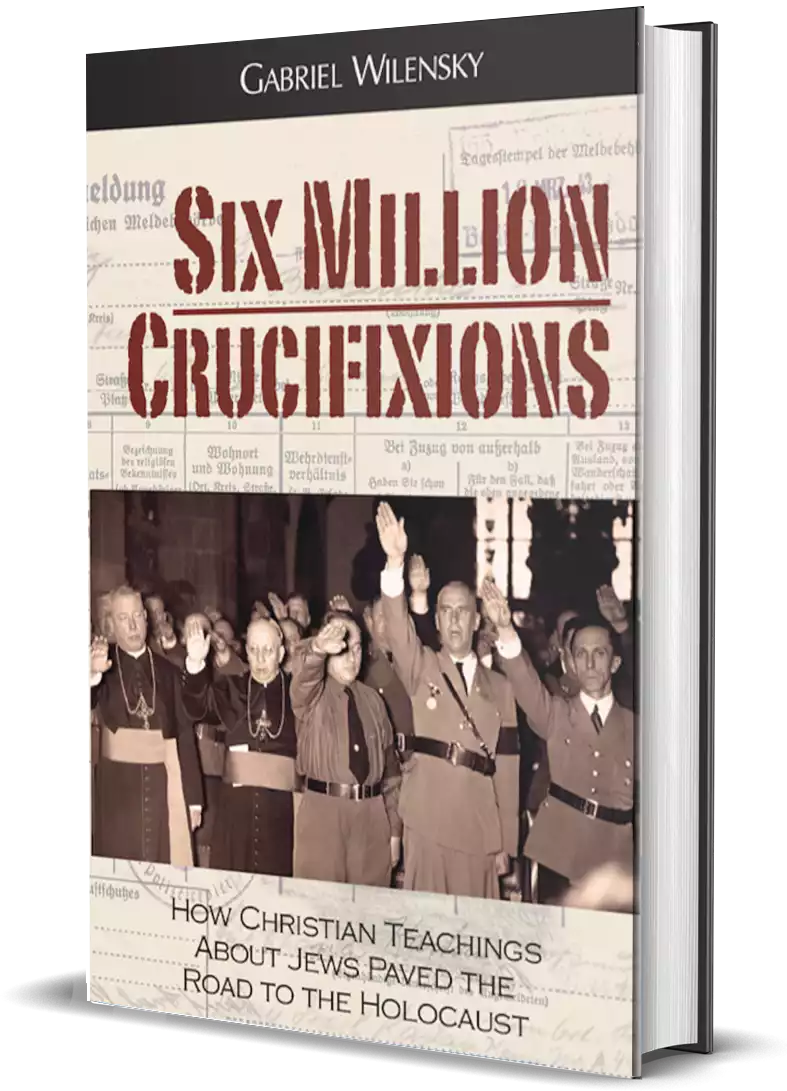
Grab Your Copy Today!
Six Million Crucifixions
Traces the history of antisemitism in Christianity and the role that played in making possible the Holocaust.
Want to stay informed about the topic?
Subscribe below.